


Wooden play kitchen: at what age should you give one and how to choose the right one
In brief: you can introduce a first play kitchen set around 18 months, the age when children start to imitate actions from around the house: stirring, pouring and pretending to eat. Start with a few simple, sturdy pieces, add food and utensils around age 2, and then recipe sets and a small kitchen really come into their own around age 3.
The ideal play kitchen set is not the same at 18 months, 2 and a half years and 4 years old. Here is how to navigate it step by step, and the criteria that will help you choose a set that will last for several years.
Why children love play kitchens so much
The kitchen is the room where children spend the most time observing adults. They see the pots, hear the blender, smell the cooking, and above all, they understand that important things happen there. A play kitchen allows them to reproduce these actions at their own height.
Behind the play, the learning is very real: fine motor skills when pouring or cutting, vocabulary for food and utensils, first notions of sorting and quantity, and then group play when they have to serve the whole family or their soft toys. It is one of the richest forms of imitation play.
At what age should you give a play kitchen set?
There isn't one single age, but three main stages. In any case, always check the minimum age indicated on each product page.
Around 18 months: a few pieces to handle
At this age, children are not yet cooking: they are transferring, stacking and handing a cup to everyone. A few pieces are enough, provided they are large and easy to grasp. A silicone set like the one from Mushie, with its teapot and ribbed cups, is well suited to this first type of play: light and unbreakable, it can follow the child into the bath or the garden.

Price: €29.90. Discover the Mushie silicone set
Around 2 years old: food and first utensils
Children start to act out little stories: they go food shopping, prepare a meal, serve their doll. It's the right time to offer them food items to recognise and name. The Janod basket of 24 fruits and vegetables brings together a nice variety in a real little basket, which can also be used for playing shop.

Price: €29.99. See the basket of 24 fruits and vegetables
You can add metal utensils, such as the Janod kitchen accessories: colander, frying pan, saucepan, ladle or skimmer. Sold individually at €4.99, they allow you to complete the kitchen set little by little.
Around 3 years old: real cooking and recipes
From age 3, play becomes much more elaborate. The child follows a recipe, cuts, mixes, cooks and narrates everything they do. Themed sets really come into their own at this point.

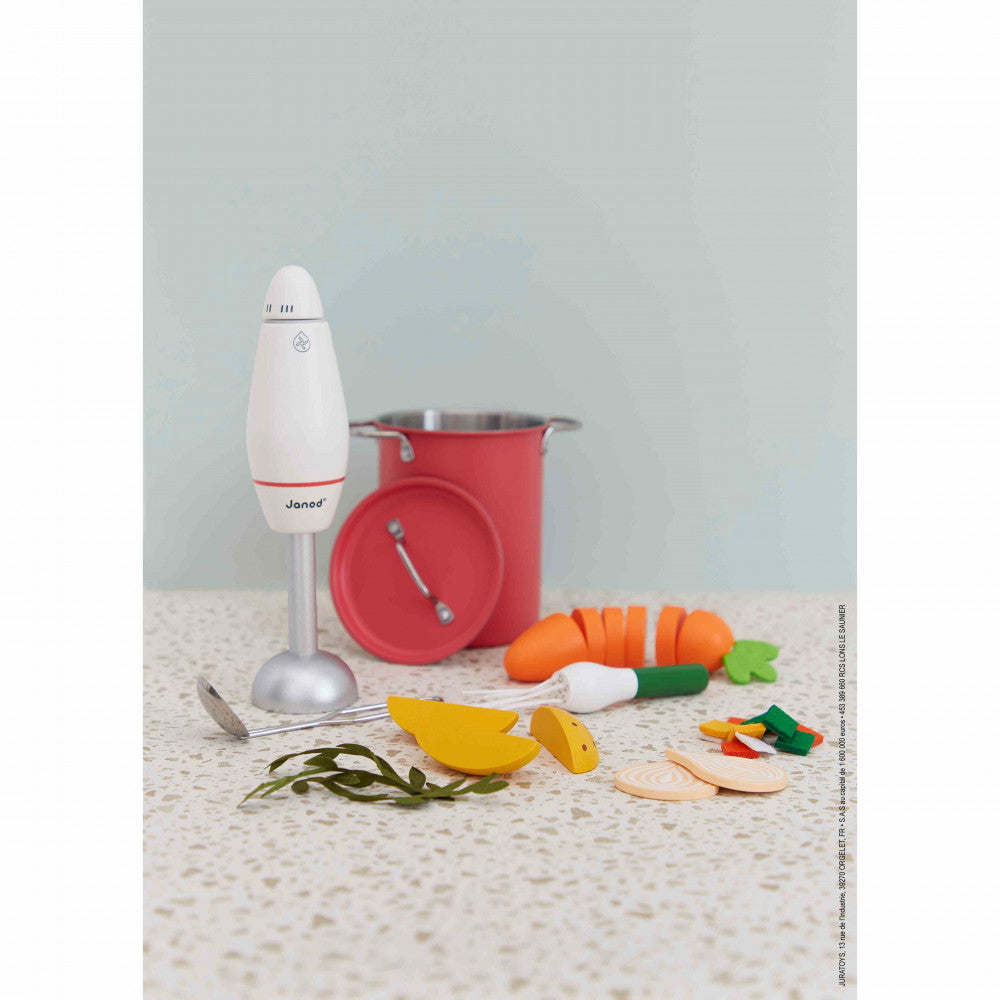
The Janod soup set is one of our favourites: 43 accessories, vegetables to cut, a metal pot and a wooden blender. Everything you need to prepare a soup from start to finish, and serve it.
Price: €29.99. Discover the soup set
In the same spirit, the Pasta Mix set and my pastry workshop (€29.99 each) allow for menu variety. And for fans of world cuisine, the Oli & Carol ramen bowl (€34.90) is always a hit.
Should you invest in a wooden play kitchen?
A kitchen is not essential for playing at cooking: an upturned box or a corner of a table works just fine. But it gives the play a space of its own, and children return to it much more often. If you are hesitant, ask yourself two questions: do you have the space, and is the child at least 2 and a half? If yes, it is one of the gifts that will be used for the longest time.
The Mamie Soleil small kitchen, Janod

A compact format, practical when space is limited, with an oven, clicking knobs and nine accessories to start playing right away. Its retro look and soft colours fit easily into a bedroom or living room.
Price: €49.99. See the Mamie Soleil small kitchen
To complete it, the Mamie Soleil coffee machine from the same range (€29.99) is often a huge hit with children who see their parents making coffee every morning.
Wood, silicone or metal: which material to choose?
Wood is the most durable. It withstands drops, is passed down from one child to another and ages well. Check that the paints are water-based and that the toy carries the CE marking, which is mandatory for all toys sold in Europe.
Silicone is particularly suitable for the youngest ones: light, flexible and washable, it also withstands bathwater.
Metal adds realism to the utensils. Children love the sound of pots and pans, the neighbours slightly less so.
Plastic remains the most common and the cheapest, but it breaks more easily and is rarely kept from one child to another. In our selection, we give pride of place to wood, silicone and metal.
How to choose a kitchen set: 4 criteria
Piece size. Before 3 years old, anything that can go into the mouth must be large enough not to be swallowed. The warning "not suitable for children under 36 months" signals the presence of small parts: before this age, choose larger pieces and stay nearby during play.
Realism. Children prefer objects that look like real ones. A recognisable egg box, a block of butter or a milk bottle nurture the play more than a set of abstract shapes.
Possibility to expand. A kitchen set is built over several years. Choosing a range where you can buy pieces individually allows you to enrich it on every occasion.
Storage. A basket, a crate or a kitchen with shelves: without storage, pieces get scattered and interest in the play fades.
Building your kitchen set little by little with Erzi

Erzi is a German manufacturer specialising in wooden food items. Each piece is sold individually, from a slice of bread to a box of six eggs, including jars of jam, a block of butter or a milk bottle. It is the ideal solution to complete an existing set, for small gifts between two big occasions, or to fill an advent calendar with real little toys.
Price: from €1.20. See the full Erzi range
Kitchen play: for girls as much as for boys
All children see adults cooking, and all of them want to imitate them. Kitchen play has no gender: it is a game of daily life, and little boys play with the same seriousness as little girls.
At Maison Canailles, we love kitchen sets that are built over time. A few nice pieces to start, then a new one for every occasion, until the day the child serves you a real full menu.
Frequently asked questions
At what age does a child play with a kitchen set?
The first gestures appear around 18 months: pouring, stirring, pretending to drink. Around age 2, the child strings together small scenes, and from age 3, they invent real stories. Many children continue playing with kitchen sets until age 6 or 7.
How many pieces do you need to start?
Around ten is more than enough: a saucepan, a frying pan, a plate, cutlery and some food items. Too many pieces at once scatter their attention. It is better to add more over the months.
How do you wash a wooden kitchen set?
With a slightly damp cloth, without ever soaking it or putting it in the dishwasher, as the wood would swell. Silicone and metal can be washed with soapy water. Always follow the care instructions indicated on the product page.
From what age should you give a wooden kitchen?
Around 2 and a half or 3 years old, when the child can stand for a long time and starts to invent scenarios. Also check the height of the worktop: the child must be able to play without having to stand on tiptoes.
To go further
Our entire selection is gathered in the kitchen play collection, and more broadly in our imitation games. If you are looking for a Christmas idea, our guides by age are waiting for you: from 1 to 2 years, from 2 to 3 years and from 3 to 4 years. And to understand how a child's needs evolve, read our guide on which toy to give according to age.
Mallaury, founder of Maison Canailles
Mum to a little boy since 2024 and passionate about e-commerce, I personally select every toy in the shop. Most of them were first adopted at home, by my son. Learn more about Maison Canailles
Read more
Clothes that are too small, stuffed animals in triplicate: birth gifts often look the same. Here are ten useful and beautiful ideas that can be used from the very first weeks or become true keepsakes.
Pretending to cook, taking care of a doll, running a cash register: imaginative play is one of the most important aspects of early childhood. What it provides, how it evolves between the ages of 1 ...